
What are the XO levels of autonomy?
Fully manual
ARC: No Autonomy
Assisted operation
ARC: Operations Assistance
Partial automation
ARC: Regulatory Automation
Conditional autonomy
ARC: Advanced Regulatory
High autonomy
ARC: Select Autonomy
Full autonomy
ARC: Full Autonomy
The unit is run and maintained by people.
AI advises or prepares actions; people decide and act.
Control loops hold set points; automated systems carry out approved actions.
The unit runs itself in defined conditions.
The unit runs and maintains itself.
The unit runs and maintains itself fully.
No automated decision: people decide and act.
No automated decision: people decide and act; AI advises or prepares actions.
Human in the loop: people approve the actions the system carries out, and can override at any time.
Human in the loop: people approve the significant actions the system takes, and step in outside defined conditions.
Human on the loop, and in the loop for every high-risk intervention.
Human out of the decision loop: people take no operating decisions but can stop the unit and take back control.
Control and unit operations
Operators run the unit by hand from the control room; field operators make rounds, take readings and operate equipment locally.
Advisory tools flag anomalies and propose set point changes; operators decide and enter every change themselves. Field rounds continue, helped by mobile tools.
Control loops hold set points; the system carries out moves an operator has approved, and operators monitor and override. Field operators handle local tasks.
Advanced control runs the unit inside its defined operating conditions, including most abnormal ones; operators supervise, step in outside them and lead start-ups and shutdowns. Robots and drones take over routine rounds.
The unit runs itself, including most transitions, and can be supervised remotely. A person approves every high-risk intervention; operators practise running the unit by hand.
No routine human operation; supervision is remote. People can stop the unit and take back control at any time.
Maintenance and technical support
People plan maintenance and inspection on fixed intervals and after breakdowns, and carry out all the work.
Predictive tools advise on maintenance and inspection frequencies and draft work orders; planners and engineers decide and approve each one.
Condition monitoring runs automatically; the system raises and schedules work orders once a planner approves them; technicians do the work.
Routine on-stream inspection is done by robots and drones; the system schedules condition-based maintenance within approved rules; people handle exceptions.
The system plans and carries out routine maintenance and inspection on-stream; a person approves every change to maintenance or inspection frequencies and every task on a barrier.
Maintenance and inspection are continuous and automated on-stream, including decisions on their frequency; people do what automation cannot and the work at planned shutdowns.
HSE
People prepare permits and risk assessments, monitor the plant and investigate incidents.
AI drafts permits and risk assessments and finds patterns in incidents; HSE and permit roles check and sign every document.
The permit system checks isolations and conflicts between jobs automatically; the issuer approves each permit. HSE roles approve every change the system proposes.
Operating limits and emissions are monitored continuously and automatically; HSE roles review exceptions. Take-over drills keep operators able to run the unit by hand.
The system manages routine permits for automated work; a person approves every action on a barrier. HSE roles verify barrier performance, and investigations include the system's actions.
People keep oversight, governance and accountability; they audit the system's decisions after the fact, test the stop function and take-back, and investigate events.
A high-risk intervention is any action that cannot be undone or that acts on a safety barrier, including changes to maintenance and inspection frequencies. At every level people stay in command: they keep oversight, governance, accountability and the means to take back control.
The plain-language titles are ours; ARC’s names are shown under each one. Open a section for the detail at each level.
What is specific to the XO definitions?
- Each unit is evaluated on its own. XO rates each unit, not the whole asset. Across a refinery one unit can be at level 5 and another at level 0; a single rating for the asset would average them out and lose what each unit needs.
- The whole management system is assessed. XO assesses the whole management system, not only the operation of the plant. Maintenance, inspection, technical support, HSE and governance change with each level and are assessed with it. The published levels (ARC, WIB/NAMUR) describe the plant and its automation only.
How does the operating management system evolve?
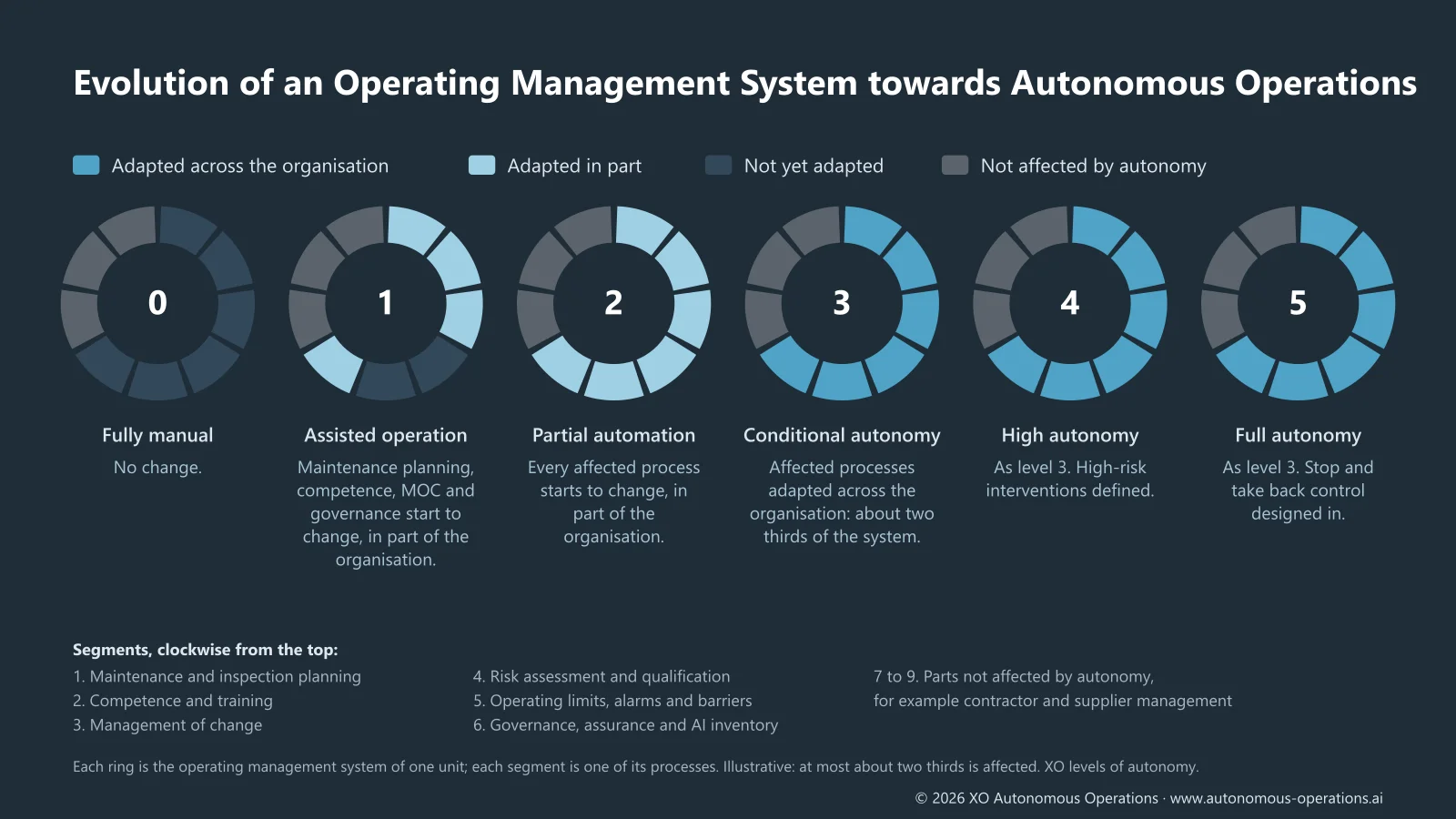
To integrate automation safely as a unit moves up the levels, its operating management system7 has to evolve with it. Change starts at level 1 in the processes closest to the new tools: maintenance and inspection planning, competence and training, which now has to include machine learning and AI, management of change, and the inventory of AI and data in use. It begins in the part of the organisation that uses them. By level 2 every affected process has started to change, and from level 3 the affected processes are adapted across the organisation. They make up about two thirds of the management system at most; the rest, such as contractor and supplier management, is not affected by autonomy. Levels 4 and 5 add depth: the high-risk interventions that still need a person, and the means to stop the unit and take back control.
Where do the published levels fall short?
The published levels describe the plant and its automation. They say little about the organisation that runs it. XO Autonomous Operations has changed the definitions to cover more than operation: maintenance, inspection and governance as well. To use the car comparison, a level 5 car does not only drive itself. It decides for itself when it needs servicing and takes itself to a fully automated garage, instead of waiting for the mileage the manufacturer recommends. XO addresses four weaknesses in the published levels.
- Governance. The levels describe what the plant does, not who is accountable for it. At every level, including level 5, people keep oversight, governance, accountability and the means to take back control, and the operating management system has to provide for them.
- Maintenance and inspection. WIB/NAMUR describe human work at level 5 as centred on maintenance during planned shutdowns. In practice an operator wants as much maintenance and inspection as possible done on-stream, without waiting for a turnaround. In XO’s reading, maintenance and inspection are progressively automated as a site moves up the levels, and they are carried out continuously, not only during planned shutdowns.
- Unit, not site. The published levels 4 and 5 are defined across a plant (“selected” or “all” units). XO applies the scale to each unit, because one unit can be at level 5 while another is at level 0, and an average rating for the site would hide that.
- Human in the loop. The published levels do not say plainly where people sit. XO states it for every level. At level 4 the unit runs and maintains itself, but every high-risk intervention, meaning any action that cannot be undone or that acts on a safety barrier, still needs a person in the loop. At level 5 people are out of the decision loop but can stop the unit and take back control.
Where do energy and chemical operators stand?
In a Schneider Electric study of 400 senior executives in energy and chemicals across 12 countries, reported by ARC Advisory Group in March 2026, organisations placed themselves at an average of 3.52 out of 5 on ARC’s model, with an ambition of 4.02 by 20308. These are self-assessments.
What changes in safety management as units move up?
Where do your units sit, and what does your management system need for the next step? See how XO Autonomous Operations helps and what changes at each level, or start with an autonomous operations briefing.
Sources
- SAE International, J3016, Taxonomy and definitions for terms related to driving automation systems for on-road motor vehicles, April 2021: the levels of driving automation.
- ARC Advisory Group, What is autonomous operations?, Autonomous Operations Maturity Model.
- R. Litjens, H.-J. Henkel, J. Opmeer, Achieving Autonomous Operations: an end-user focused approach and maturity model by WIB/NAMUR, atp magazin 67(11-12), 25 November 2025.
- EASA, Artificial Intelligence Concept Paper Issue 2: guidance for Level 1 and 2 machine-learning applications, 6 March 2024: levels 1 to 3B, for where people sit at levels 1, 2, 3 and 5.
- IAEA, Nuclear Energy Series NR-T-1.26, Considerations for Deploying Artificial Intelligence Applications in the Nuclear Power Industry, 2025, section 1.3.1: US NRC levels of AI and autonomy and NUREG-0700 levels of automation, for levels 3 and 5.
- Singapore, Model AI Governance Framework for Agentic AI, version 1.5, 20 May 2026: levels of human involvement, and human approval before irreversible actions, for levels 1, 2 and 4.
- IOGP Report 510, Operating Management System Framework for controlling risk and delivering high performance in the oil and gas industry, June 2014: the term operating management system.
- ARC Advisory Group, The tipping point: AI and the race for autonomous energy operations, 26 March 2026.
Questions
What are the levels of autonomous operations?
In the process industries the usual scale is ARC Advisory Group's Autonomous Operations Maturity Model, refined by WIB and NAMUR: level 0 No Autonomy, level 1 Operations Assistance, level 2 Regulatory Automation, level 3 Advanced Regulatory, level 4 Select Autonomy, level 5 Full Autonomy. The XO levels of autonomy are XO Autonomous Operations' own version: they rate each unit, say where people sit at each level and cover maintenance, inspection and governance.
What level of autonomy have energy and chemical operators reached?
In a Schneider Electric study of 400 senior executives in energy and chemicals, reported by ARC in March 2026, organisations put themselves at 3.52 out of 5 on average, with an ambition of 4.02 by 2030.